

Medcurity delivers the hospital HIPAA Security Risk Analysis across every delivery site under one engagement, with an onsite physical-safeguard review under 45 CFR 164.310 and expert human review, built for hospitals, critical access hospitals, and rural facilities.
A hospital is told it needs continuous monitoring, automated evidence collection, and a live compliance dashboard. Those tools help a security team keep several certifications current, and they are not the same thing as the document the Office for Civil Rights asks for first. The HIPAA Security Rule requires an accurate and thorough Security Risk Analysis of every system that touches electronic protected health information, assessed against 45 CFR 164.308, 164.310, and 164.312. Automated evidence collection can show that a control was checked. It cannot, on its own, tell you whether the physical safeguards at a satellite campus were ever assessed, or whether the analysis reached every delivery site.
Medcurity runs the Security Risk Analysis the way a hospital or a critical-access or rural facility actually operates: every delivery site assessed under one engagement, an onsite physical-safeguard review where 45 CFR 164.310 calls for it, and expert human review of the findings rather than a self-scored questionnaire. The analysis maps to the HIPAA Security Rule and to NIST SP 800-66 Revision 2, the guidance OCR points to for implementing the Security Rule, so the deliverable speaks the language an auditor and a health-system security team both read.
Where a hospital is really an enterprise integrated delivery network standing up a multi-framework GRC program across SOC 2, ISO 27001, and HIPAA at once, a horizontal compliance-automation platform, or a firm like Clearwater built for that scale, may be the closer fit. Where the obligation is a defensible, multi-site HIPAA Security Risk Analysis with onsite physical-safeguard depth, a healthcare-native engagement is the closer fit.
Evolving regulations and detailed requirements can be hard to work through, but conducting a security risk analysis (SRA) each calendar year is essential for a hospital’s HIPAA compliance. Regular risk assessments provide critical insight into your overall security posture and can lessen your chances of a breach.
Our HIPAA specialists and cloud-based platform bring clarity to compliance and streamline security risk management, so you can confidently meet regulatory requirements and focus on your core mission.
Medcurity enables hospitals to efficiently evaluate threats and vulnerabilities across all information systems. Trusted by hundreds of organizations, we simplify compliance and align with strict OCR guidance to help you safeguard sensitive patient data.
HIPAA Security Rule requirements can be nuanced and difficult to follow. Our compliance specialists are here to guide you through the details so your SRA meets OCR standards.
Centrally manage your security risk analysis with Medcurity's AI-powered compliance platform for accuracy and completeness without the confusion or paper-driven processes.
Identify hidden security threats and gaps in your administrative, technical, and physical safeguards. Gain insight on your overall security posture and compliance status.
Conduct your security risk analysis with helpful guidance every step of the way to meet OCR expectations for risk identification, assessment, and mitigation are met.
Helpful prompts and in-tool resources provide guidance each step of the way.
Receive audit-ready documentation and summary reports required for HIPAA compliance.
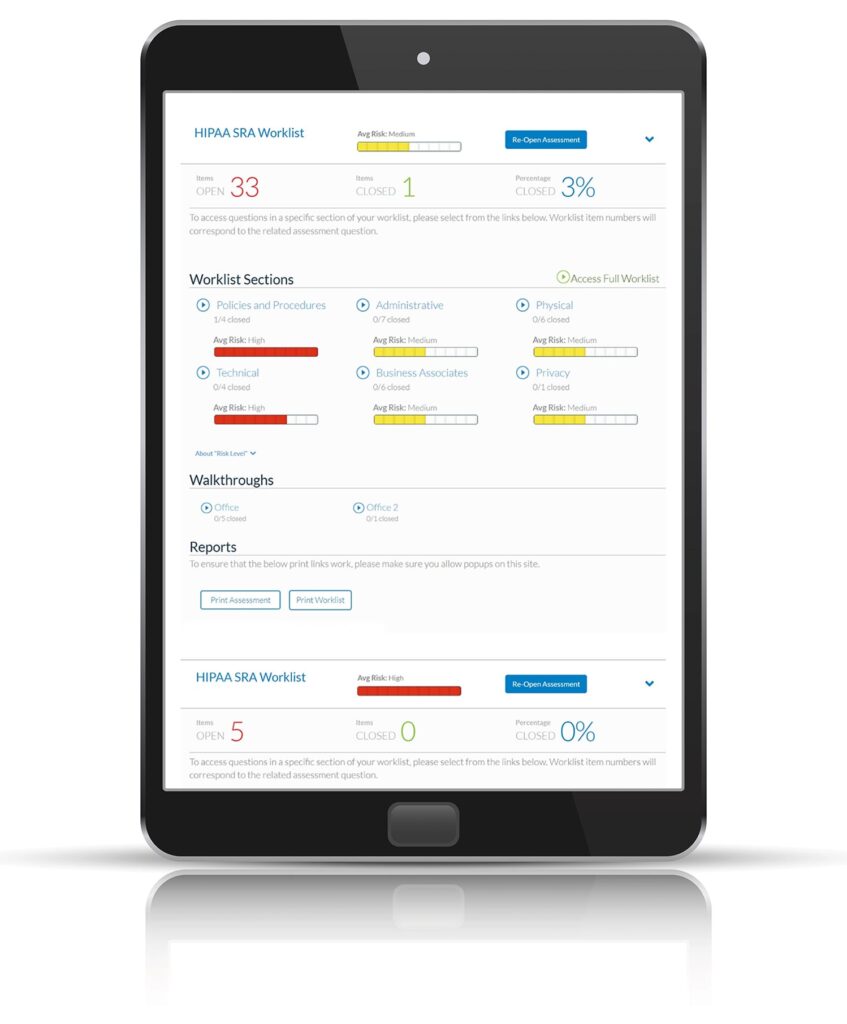
Easily identify areas that need improvement and track your organization's progress.
As part of Medcurity’s expanded security risk analysis offerings, our compliance specialists provide virtual or onsite walkthroughs and expert guidance. We help hospitals assess their unique risk environment and provide personalized mitigation strategies. This translates to a better overall security posture and lessens your chances of a breach.

Review existing policies and procedures that govern how your organization and business associates safeguard protected health information, including vendor management, HIPAA training, security risk assessments, and data breach response plans.
Evaluate the security measures currently in place to protect facilities, equipment, and electronic media from unauthorized access and environmental hazards. Keep the necessary policies updated and viewable in compliance with HIPAA.
Assess the integrity and availability of your tools and procedures used to control access to electronic protected health information (ePHI), such as user authentication and encryption. Conduct an NVA with an SRA to further improve security.
Our library of HIPAA policy and procedure templates, developed by experts, provides a solid foundation for your hospital’s compliance efforts.
Create policies suited to your unique needs and share them easily with whomever you choose. Receive prompts prior to review dates and keep policies current with ease, all with our AI-powered platform.
Hospitals and health networks rarely fail HIPAA scrutiny for lack of effort — they fail because the analysis was scoped like a clinic’s. Five capabilities separate an SRA that holds up at hospital scale from one that doesn’t.
HIPAA’s physical safeguards — facility access controls, workstation security, device and media controls under 45 CFR §164.310 — cannot be evaluated from a screen. A Medcurity assessor walks your buildings: the server-room door that gets propped open, the workstation left signed in on a nursing floor, the media cabinet at the satellite clinic that never got a lock. Findings come from your facilities, not from your answers about them.
ePHI at a hospital lives far beyond the data center — nursing units, imaging, lab, pharmacy, billing, and the clinics across town all hold it. Medcurity structures the assessment around how hospitals actually operate, with role-based workflows that let each department answer for the systems it owns while the result remains one accurate, thorough analysis rather than a pile of departmental checklists.
A health network’s board needs one picture; its legal entities each need their own. Medcurity assesses every entity on its own terms and rolls risk up to a network-level view with entity-level detail preserved underneath — not a single blended assessment, and not a stack of disconnected reports.
Compromised credentials surface on dark-web markets before they are used against you. Medcurity watches your domains year-round, so exposed credentials become findings you remediate instead of breaches you disclose. HHS OCR’s own breach data shows hacking and IT incidents driving both breach counts and individuals affected, with network servers the most common location — this is the risk an annual questionnaire cannot see.
The vendors touching ePHI multiply a hospital’s exposure well beyond its own network. Medcurity’s Vendor Risk Management handles hundreds of business associate relationships at once — questionnaire-scored vendors, and BAAs tracked through negotiation, e-signature, and renewal — and feeds vendor risk into the SRA itself instead of leaving it in a side spreadsheet. In reported breaches, business associates account for an outsized share of affected individuals relative to their share of incidents.
On scope: a Security Risk Analysis never requires a connection into your EHR. The EHR is assessed as an asset, alongside every other system that stores, processes, or transmits patient data.
The Security Rule asks for an "accurate and thorough" analysis at §164.308(a)(1)(ii)(A) — a judgment made by people, which is why HIPAA experts review every guided SRA before it is finalized. Medcurity has a 100% acceptance rate with the HHS Office for Civil Rights (OCR), and supports organizations from 50 to 5,000+ employees.
Grays Harbor · Weiser Memorial · Willapa · Greater Baltimore Medical Center
From critical-access and rural hospitals to a major metropolitan medical center.
"Medcurity has been a trustworthy resource for Harbor Regional Health Community Hospital. As a rural hospital, we value partners who help us stay on top of policy and federal program changes. Thank you for providing an intuitive and comprehensive platform, as well as expert advice, that enables our staff to focus on providing exceptional care for our community."
— Tom Jensen, Chief Executive Officer, Harbor Regional Health Community Hospital
"Medcurity has been a great partner and advisor. They walked us through completing our HIPAA Security Risk Analysis last year, and we are working with them again this year."
— Brian Eichman, MHA, RHIA, Operations Director, Catholic Health Initiatives, Roseburg, OR
"Medcurity has quickly become a trusted partner in ensuring our organization is compliant. Joe and his team are top notch and support our rural communities with real-time feedback."
— Desiree Sweeney, Chief Executive Officer, NEW Health
4.92/5 from the 1,000+ healthcare organizations Medcurity has served since 2018.
Your named Medcurity advisor stays engaged between assessments — quarterly check-ins, one remediation worklist with owners and deadlines, a policy library kept current, and board-ready reporting. When OCR — the HHS Office for Civil Rights — or a federal program reviewer asks for evidence, it is already organized.
Talk to our team — we’ll scope your entities, walk your facilities, and show you what an audit-defensible hospital SRA looks like.
"Thank you for providing an intuitive and comprehensive platform, as well as expert advice that enables our staff to focus on providing exceptional care for our community."
Tom Jensen Chief Executive Officer, Harbor Regional Health Community Hospital